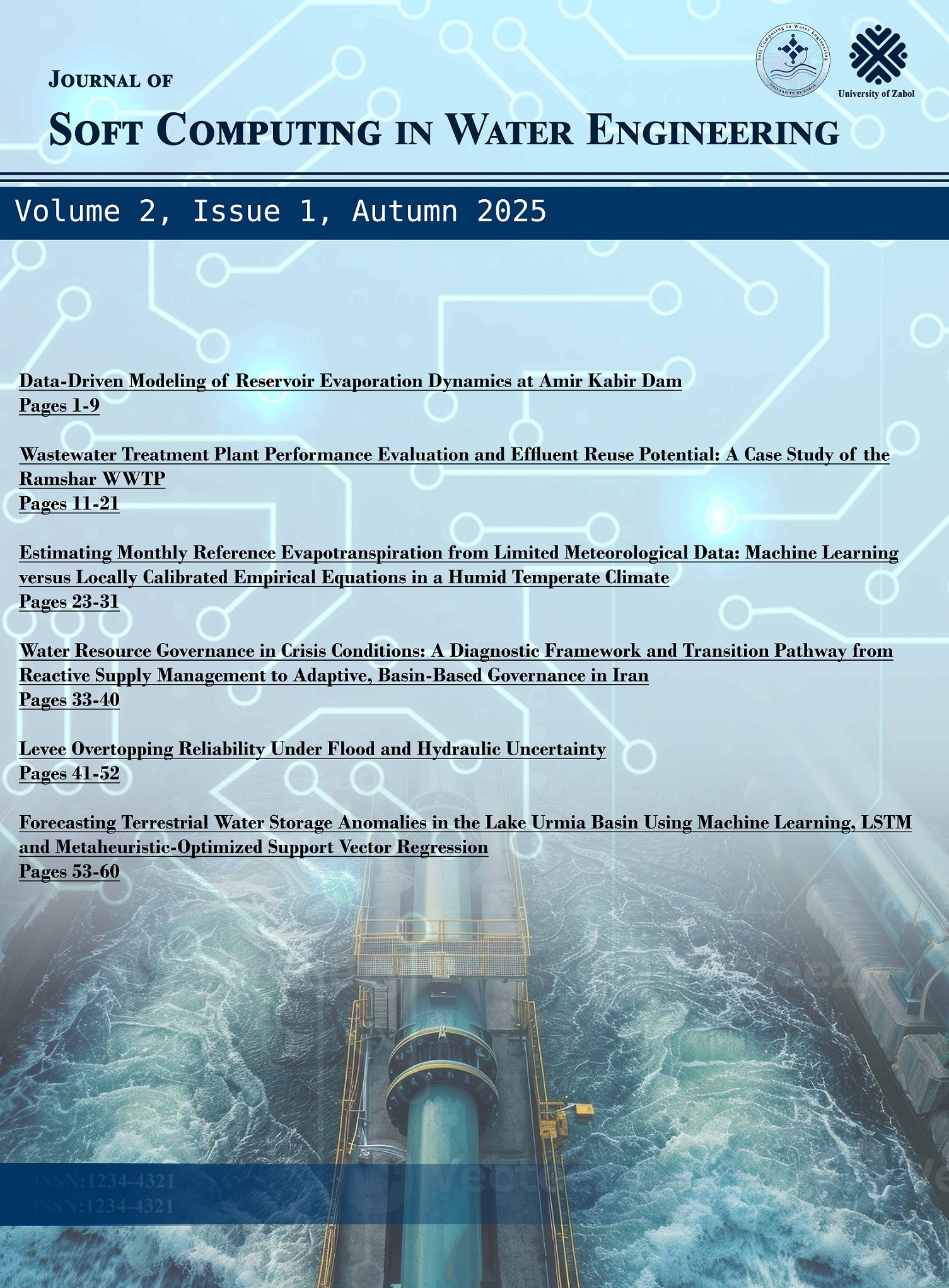
Document Type : Original Article
Authors
1
Agriculture Institute, Research Institute of Zabol, Zabol, Iran
2
Ph.D, Department of Water Engineering, University of Birjand, Birjand, Iran
10.22034/scwe.2026.603253.1015
Abstract
The FAO-56 Penman–Monteith (PM) equation is the standard for reference evapotranspiration (ET0), but it requires radiation, humidity and wind data that are often missing. This study used 24 years (1976–1999) of daily weather records from the Wageningen (Haarweg) station in the Netherlands, aggregated to 284 complete months. It compared six empirical equations (Hargreaves–Samani, Thornthwaite, Oudin, Makkink, Priestley–Taylor and Turc), in original and locally calibrated form, with five data-driven models (multiple linear regression, support vector regression (SVR), Gaussian process regression (GPR), XGBoost and a multilayer perceptron) for six input combinations. All models were evaluated by six-fold blocked cross-validation using 4-year blocks. Monthly PM-ET0 averaged 631 mm yr⁻¹, peaking at 104 mm in July. Annual Tmax, Tmin, actual vapour pressure and wind speed increased significantly, whereas the increase in ET0 (+4.0 mm yr⁻¹) was marginal (p = 0.051). Sensitivity analysis showed that ET0 was most responsive to vapour pressure (−13.4% for +10%) and maximum temperature (+8.1% for +1 °C). The original empirical equations had RMSEs of 9.1–13.8 mm month⁻¹, with Hargreaves–Samani overestimating by 15% and Makkink underestimating by 15%. Local calibration reduced the errors to 4.4 mm month⁻¹ (Makkink) and 6.1 mm month⁻¹ (Hargreaves–Samani). With temperature and extraterrestrial radiation only, GPR reached RMSE = 5.3 mm month⁻¹ (NSE = 0.977), better than the calibrated Hargreaves–Samani equation. Adding vapour pressure reduced the error to 3.1 mm month⁻¹, and the full input set gave 1.4 mm month⁻¹ (NSE = 0.998). GPR was the best model for every input combination, while XGBoost was the weakest non-linear model. In this humid climate, humidity information is at least as valuable as radiation for data-driven ET0 estimation, and a calibrated Makkink equation remains a strong radiation-based alternative.
Keywords
Subjects